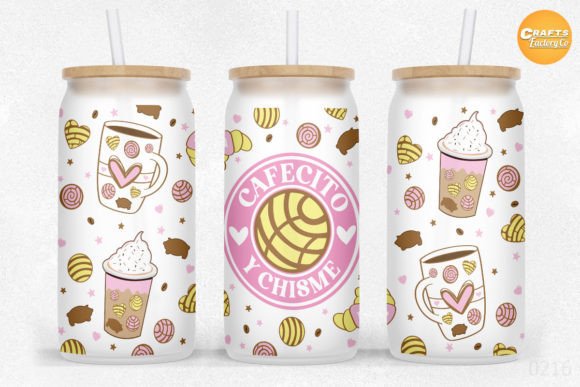
Cafecito Y Chisme 16oz Libbey Glass Can
First Impressions: Warm, Witty, and Ready for Real Stitching
As a designer who’s stitched everything from baby onesies to boutique aprons, my first glance at Cafecito Y Chisme 16oz Libbey Glass Can landed with a quiet smile—not because it’s flashy, but because it feels *lived-in*. The layout leans into playful Latinx kitchen culture: steam curling from a tiny cup, bold bilingual lettering (“Cafecito Y Chisme”), and that unmistakable Libbey glass can silhouette. It’s not overly detailed—no micro-stitch florals or dense fill areas—but the balance of negative space and confident line weight suggests strong embroidery readability. This isn’t a design begging for sublimation-only use; it’s built for thread, texture, and tactile charm.
A Real Project Test: Embroidering It on a Linen Tea Towel
Last week, I used Cafecito Y Chisme 16oz Libbey Glass Can on a natural linen tea towel for a local café’s holiday gift bundle. No sublimation—just standard machine embroidery. I chose medium-weight cutaway stabilizer and matte cotton thread in warm espresso and cream. The result? Crisp satin stitch outlines held beautifully, the “Cafecito” lettering stayed legible at 3.2" wide, and the steam swirl translated cleanly without puckering. Customers loved the warmth—and more than one asked, “Is this your original design?” That’s the mark of a strong embroidery file: it reads as intentional, handmade, and culturally grounded—not generic clip art.
Where It Shines (and Where to Pause)
Cafecito Y Chisme 16oz Libbey Glass Can works especially well for:
- Tote bag design — centered on canvas or denim, it reads clearly from across a craft fair booth;
- Sweatshirt embroidery — the clean lines hold up on fleece-backed fabric when paired with light tear-away stabilizer;
- Embroidered patch — its moderate height and open spacing make it ideal for iron-on or sew-on patches on jackets or aprons;
- Holiday embroidery — think personalized mugs (via sublimation wrap), but also embroidered oven mitts or kitchen towels for Christmas markets;
- Small shop product — it adds instant personality to slow-made goods without overwhelming the item’s function.
But be thoughtful on:
- Stretchy fabric — like jersey tees — where tight curves may distort without proper stabilization;
- Tiny hoop sizes (<5") — the full composition needs breathing room; consider cropping “Cafecito” alone for caps or baby onesies;
- Dark fabric — test thread contrast early; light cream or tan thread can disappear on charcoal; go for heather gray or rust instead;
- Dense stitch areas — while not heavy, the letterforms have enough density to benefit from reduced underlay on lightweight linens or gauze.
Design Integrity Meets Commercial Reality
This isn’t just about prettiness—it’s about trust. When an Etsy seller offers a handmade product with Cafecito Y Chisme 16oz Libbey Glass Can stitched on a cotton baby blanket, buyers don’t just see coffee—they see care, cultural resonance, and craftsmanship. That perception lifts perceived value. But it only holds if the finished product delivers: no skipped stitches in the “chisme” loop, no thread nesting in the cup handle curve, no fading after two washes. I recommend every craft business run a full-wash test on scrap fabric before listing. And yes—check licensing. Since this is labeled a Graphics file for craft projects, confirm whether resale of physical embroidered items is permitted before launching on your small shop site or craft fair table.
Practical Designer Notes You’ll Actually Use
Before loading Cafecito Y Chisme 16oz Libbey Glass Can into your embroidery software:
- Run a printable mockup in black and white—does the hierarchy hold? (Yes—the cup shape anchors the eye, then text follows.)
- Check stitch density visually: no overfill in the steam or cup base—this helps prevent stiffness on soft fabrics like baby embroidery blanks.
- Confirm your hoop size fits the full design comfortably—or plan a simple crop for custom apparel like toddler tees.
- Test thread colors on both light and dark fabric swatches. Rust + charcoal works. Yellow + black? Less so.
- Use appropriate stabilizer: cutaway for knits, tear-away for stable wovens, and fusible for lightweight silks or rayon blends.
- Ask yourself: does this support your brand voice? If your shop leans minimalist, this adds joyful contrast. If you specialize in vintage florals, it might feel tonally off.
Final Thought: A Design That Serves People, Not Just Pixels
What makes Cafecito Y Chisme 16oz Libbey Glass Can stand out among hundreds of digital embroidery files I’ve reviewed is its quiet confidence. It doesn’t try to do everything. It doesn’t cram in extra elements to look “busier.” Instead, it gives makers a sincere, stitch-ready anchor for real-life projects—whether that’s a single embroidered pillow cover for a friend’s baby shower or fifty custom sweatshirts for a Latinx-owned café’s staff launch. As a designer, I respect that restraint. As a small business owner, I value how easily it converts curiosity into connection. Just remember: always test, stabilize wisely, and let the warmth of the design shine through the thread—not hide behind it.