Computer Programmer Still Developing Graphics & Print Templates
As a blog designer who’s built over 200 editorial websites and managed visual content for digital publishers across tech, education, and creative entrepreneurship niches, I opened Computer Programmer Still Developing expecting another generic coding cliché — and was immediately surprised. This isn’t a pixelated terminal screenshot or a cartoonish robot at a keyboard. It’s a clean, confident, subtly human illustration: a focused developer mid-flow, surrounded by soft code fragments, subtle UI elements, and just enough abstraction to feel modern without sacrificing clarity. The mood is professional yet approachable, technical but not cold, and distinctly editorial — not stocky, not gimmicky, not overly playful.
It lands squarely in the “modern design” sweet spot: minimalist composition, balanced negative space, intentional line weight, and a color palette that works equally well on light and dark backgrounds. That makes it unusually versatile for real publishing workflows — especially for bloggers covering software careers, coding bootcamps, remote work culture, tech education, or freelance development. It doesn’t scream “fun tech startup”; it whispers “credible, thoughtful, in-progress expertise.” That nuance builds reader trust faster than a flashy gradient ever could.
In my latest content sprint — building a 12-part digital guide on transitioning into programming — I dropped Computer Programmer Still Developing into six key touchpoints: the blog’s main category thumbnail, the lead magnet opt-in graphic, the Pinterest pin for each lesson, the Canva template for social media graphics, the header image for the downloadable workbook, and the hero section of the email newsletter sequence. Each time, it anchored the message visually without competing with text. Its clean lines reinforced our brand identity; its quiet confidence signaled authority without arrogance — a rare win for any graphic design asset aimed at serious learners.
Here’s where Computer Programmer Still Developing delivers measurable value for publishers:
- Stronger first impression: Readers decide in under 3 seconds whether your content is worth their attention. This asset communicates competence and continuity — “still developing” implies growth, humility, and real-world relevance.
- Clearer visual hierarchy: Its balanced layout naturally guides the eye toward headline text when overlaid — no frantic cropping or opacity wrestling needed.
- Better click-through potential: On Pinterest and email previews, it stands out from oversaturated “code on screen” visuals thanks to its restrained art direction and intentional negative space.
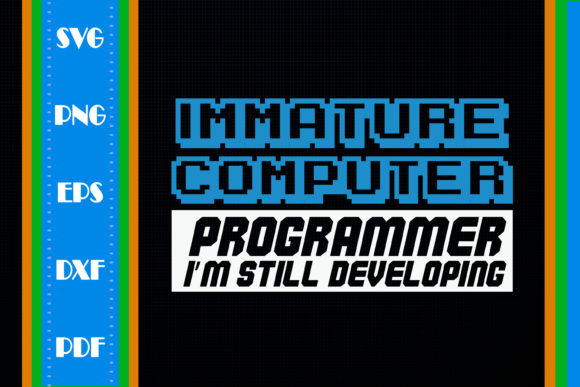
- More consistent branding: With SVG, PNG, EPS, DXF, and PDF files included in one instant digital download, you can scale it flawlessly across web, print, and vector-based tools — critical for maintaining brand cohesion across blog graphics, digital guides, and printable worksheets.
- Improved reader trust: Unlike AI-generated or clip-art-style alternatives, this feels hand-crafted and editorially intentional — signaling care, credibility, and investment in quality content marketing.
It shines brightest in high-impact, low-text-density zones: hero images, article thumbnails, Pinterest pins, blog graphics used as visual anchors, editorial accents (like section dividers or sidebar callouts), content upgrades, downloadable resources (e.g., “5 Habits of Developers Who Ship Consistently”), category visuals, newsletter headers, and social media previews — especially LinkedIn and Twitter/X where professional tone matters.
Use it carefully in contexts demanding extreme minimalism or formal gravitas: small mobile thumbnails where fine details vanish, text-heavy blog images where it might compete with body copy, low-contrast backgrounds where legibility suffers, busy layouts where visual noise overwhelms its subtlety, or corporate-facing content (e.g., enterprise SaaS whitepapers) where ultra-serious tone overrides approachability.
Before deploying Computer Programmer Still Developing in your next campaign, run these publisher checks:
- Preview it on both desktop and mobile screens — does the focal point hold at 320px width?
- Test it as a thumbnail beside your actual blog post titles — does it create contrast and recognition?
- Drop it into a live blog layout mockup — how does it breathe alongside your typography and spacing system?
- Overlay headline text in your primary font — test serif, sans serif, script, handwritten, and display variants to confirm readability and harmony.
- Check contrast ratios against your background colors — especially for accessibility compliance.
- Convert to grayscale — does the composition retain depth and hierarchy?
- Review file size: compress PNGs for web performance without sacrificing sharpness; use SVG for scalable icons or headers.
- Verify commercial license terms — essential for monetized websites, affiliate marketing pages, paid digital products, and client-facing creative design work.
What you get isn’t just another graphic — it’s a flexible, production-ready design asset built for real editorial work. The ZIP includes one SVG (ideal for responsive website headers and interactive elements), one high-res PNG (perfect for blog graphics and social media graphics), one EPS (for professional print templates and DTP workflows), one DXF (for laser-cut or CNC-compatible printable design projects), and one PDF (great for quick client proofs or internal style guide references). No hidden layers, no missing fonts, no licensing ambiguity — just clean, usable files that integrate smoothly into your existing web design, content marketing, and small business branding systems.
For online educators launching a coding course, affiliate marketers reviewing dev tools, newsletter creators curating weekly tech insights, or creative entrepreneurs building a portfolio site around technical storytelling — Computer Programmer Still Developing isn’t decoration. It’s visual strategy. It tells your audience, before they read a word, that this content understands the journey — not just the destination.